


Keynote Speech at the 2nd CSN Greece Shipping Debate - 26 Feb 2026
In an era defined by geopolitical fragmentation, trade wars, and systemic economic uncertainty, shipping can no longer be treated as a purely technical transport sector. It has become a strategic determinant of economic stability, competitiveness, and national resilience. Yet while its importance has grown, governance structures — particularly in Europe — remain fragmented and reactive.
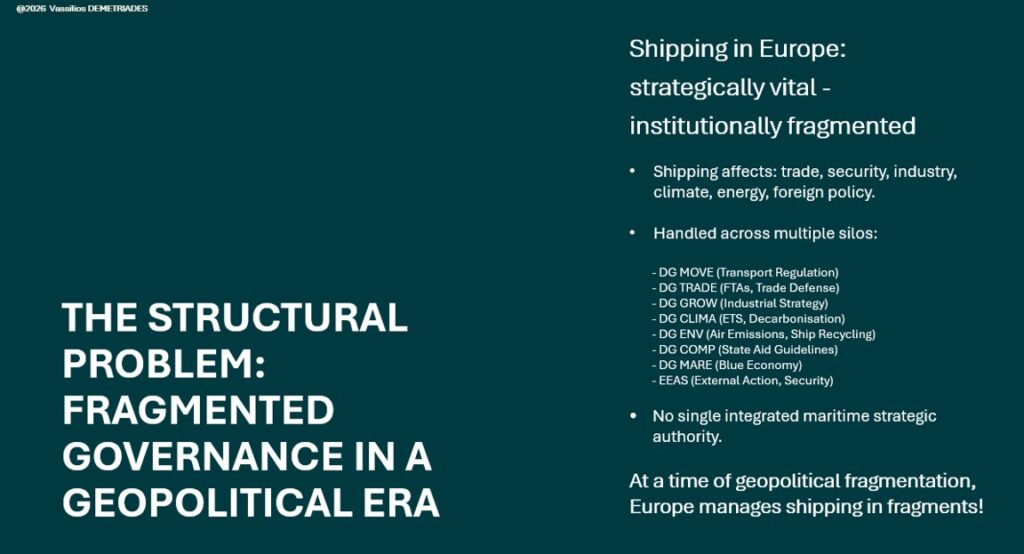
Shipping today affects trade, security, industry, climate policy, energy supply, and foreign affairs. However, policy responsibility is often divided across multiple institutional silos. Transport regulation, trade negotiations, industrial strategy, climate legislation, competition rules, and external action are handled separately, without a single integrated maritime strategic authority. At a time when geopolitics is fragmenting the global order, shipping governance remains fragmented as well.
The consequence is clear: shipping increasingly becomes the victim of policy decisions designed without maritime considerations in mind. Sanctions regimes can alter global trade routes overnight. Trade wars reshape cargo flows and distort market dynamics. Climate measures directly impact cost structures. Security crises increase insurance premiums and rerouting costs. Free Trade Agreements are often concluded without robust maritime safeguards.
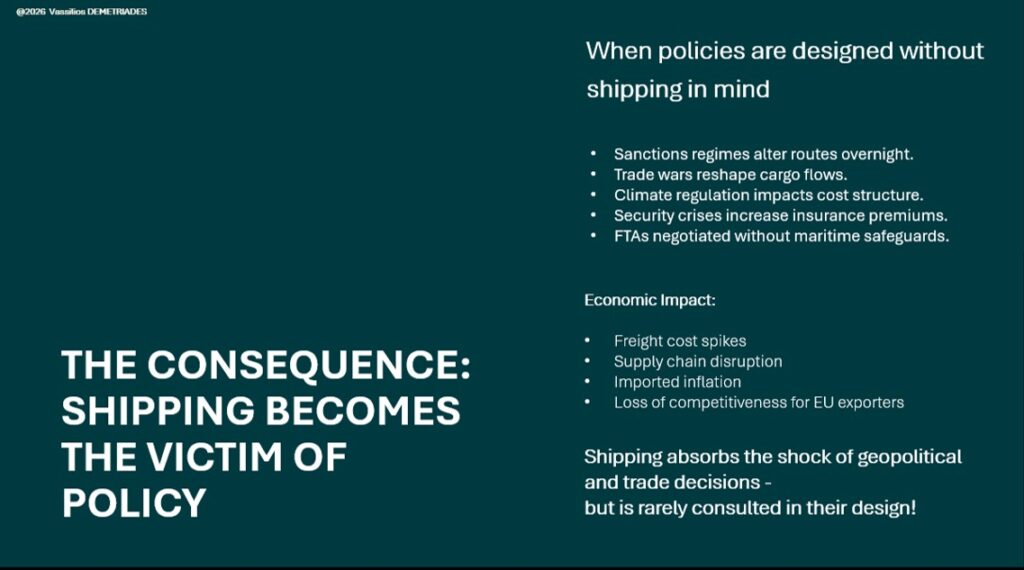
Shipping absorbs the shock of geopolitical and trade decisions — but is rarely consulted in their design.
The economic implications are immediate and measurable. Freight cost spikes translate into supply chain disruptions. Rising logistics costs feed imported inflation. Export competitiveness declines. What appears to be a geopolitical or diplomatic decision quickly becomes a macroeconomic issue. Shipping is not a neutral conduit; it is the transmission channel through which geopolitical tensions enter national economies.
Recent developments illustrate this reality. Disruptions in the Red Sea have forced longer routes, increasing fuel consumption and freight rates. Instability in the Black Sea has created volatility in grain and energy markets. Trade protectionism has led to rerouting inefficiencies and higher systemic logistics risk. In a fragmented global environment, shipping amplifies shocks across supply chains.
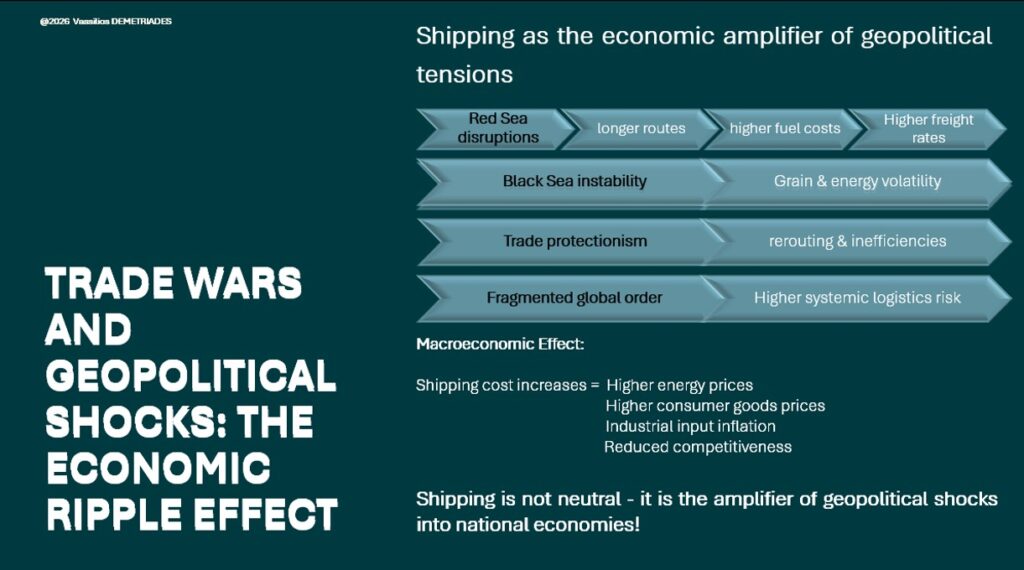
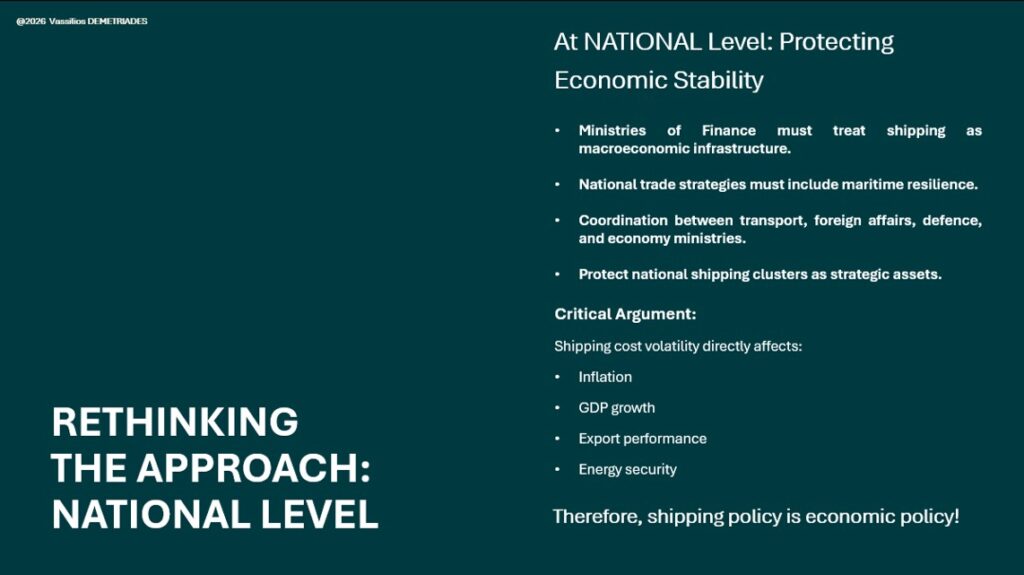
If shipping costs rise, the impact is not limited to shipowners or operators. It directly affects energy prices, consumer goods, industrial inputs, and ultimately inflation. It influences GDP growth, export performance, and energy security. Shipping policy, therefore, is economic policy.
To address this new reality, a fundamental shift is required at global, European, and national levels.
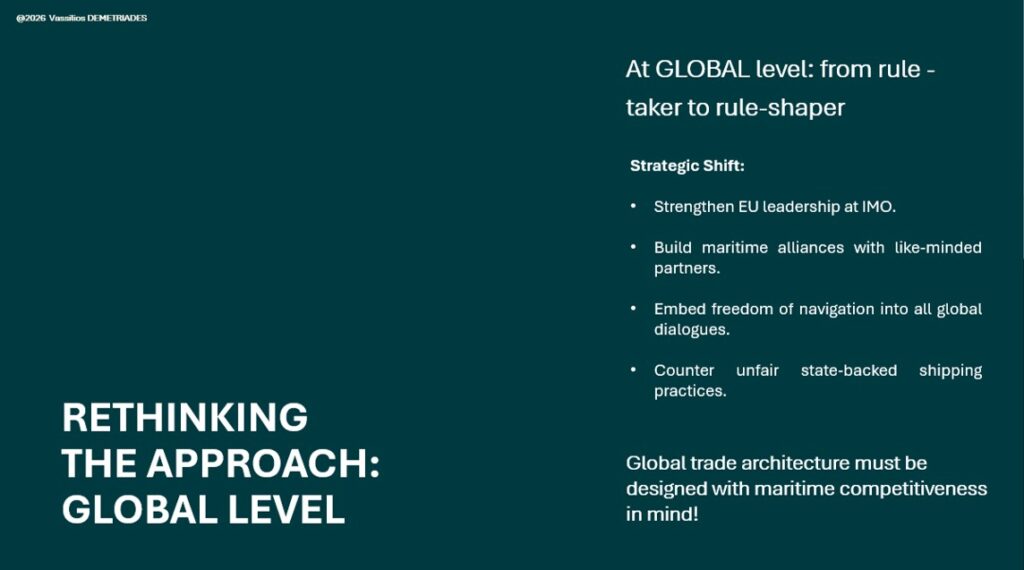
At the global level, maritime actors must move from being rule-takers to rule-shapers. Strengthening leadership in international maritime governance, building alliances with like-minded partners, embedding freedom of navigation in diplomatic dialogues, and addressing unfair state-backed shipping practices are essential steps. The architecture of global trade must be designed with maritime competitiveness in mind.
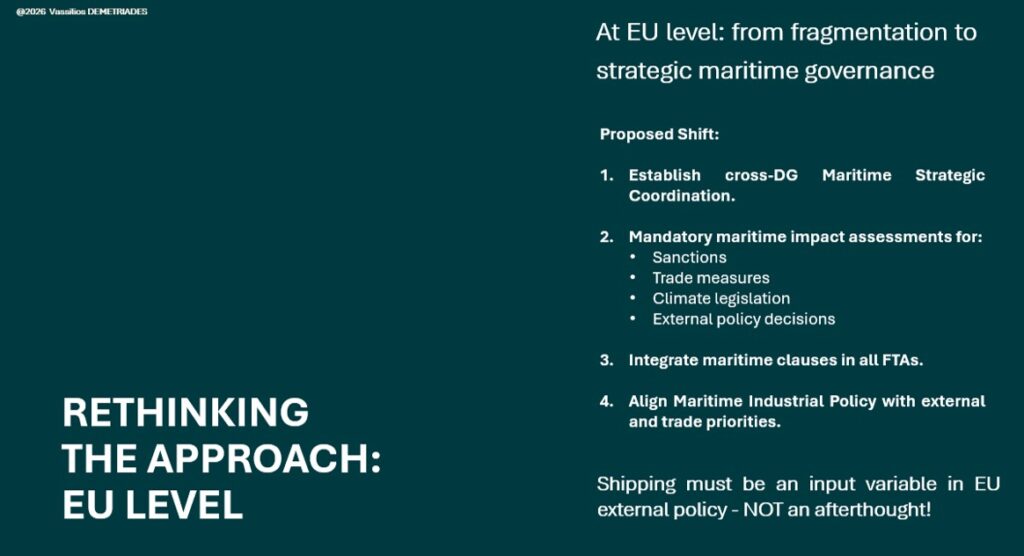
At the European level, fragmentation must give way to strategic maritime governance. Cross-departmental coordination is essential. Maritime impact assessments should become mandatory for sanctions, trade measures, climate legislation, and external policy decisions. Free Trade Agreements should systematically integrate maritime clauses. The upcoming Maritime Industrial Strategy must be aligned with trade and external priorities. Shipping must become an input variable in policy formulation — not an afterthought.
At the national level, governments must recognise shipping as macroeconomic infrastructure. Ministries of Finance should assess maritime competitiveness as part of economic stability planning. Trade strategies must incorporate maritime resilience. Coordination between transport, foreign affairs, defence, and economy ministries is essential. National shipping clusters — including shipowners, managers, charterers, shipyards, and marine manufacturers — should be treated as strategic assets.
The strategic conclusion is straightforward. In a world of trade wars and geopolitical blocs, maritime power equals economic power. External, trade, climate, and security policies cannot be designed without evaluating maritime consequences. Competitive shipping underpins resilient supply chains, lower inflation, stronger industry, and strategic autonomy.
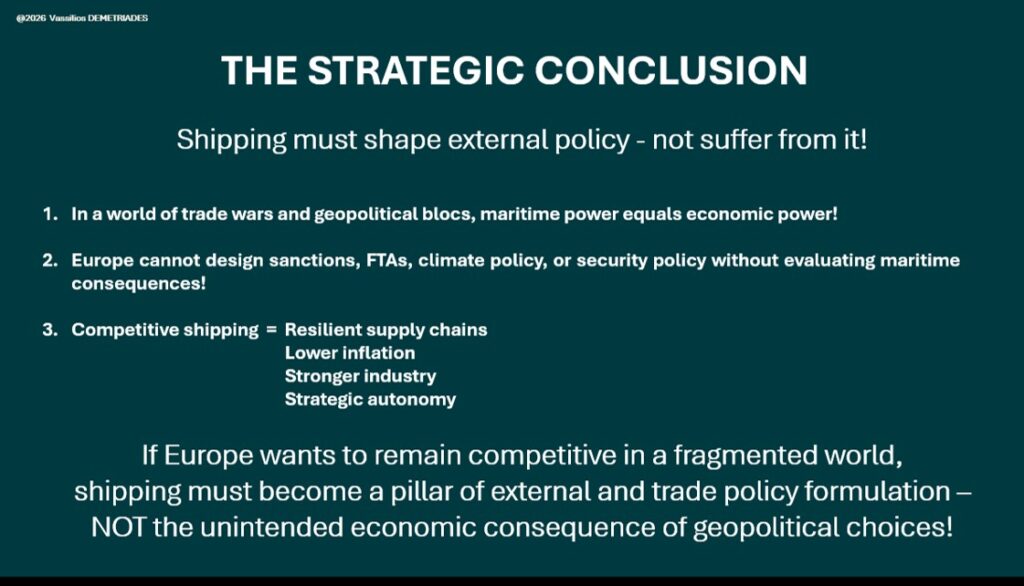
If economies want to remain competitive in a fragmented world, shipping must shape external policy — not suffer from it. It must become a pillar of trade and external policy formulation, not the unintended economic consequence of geopolitical choices.
The time has come to rethink shipping — not as a reactive sector adjusting to global shocks, but as a proactive strategic instrument capable of shaping economic and geopolitical outcomes.