

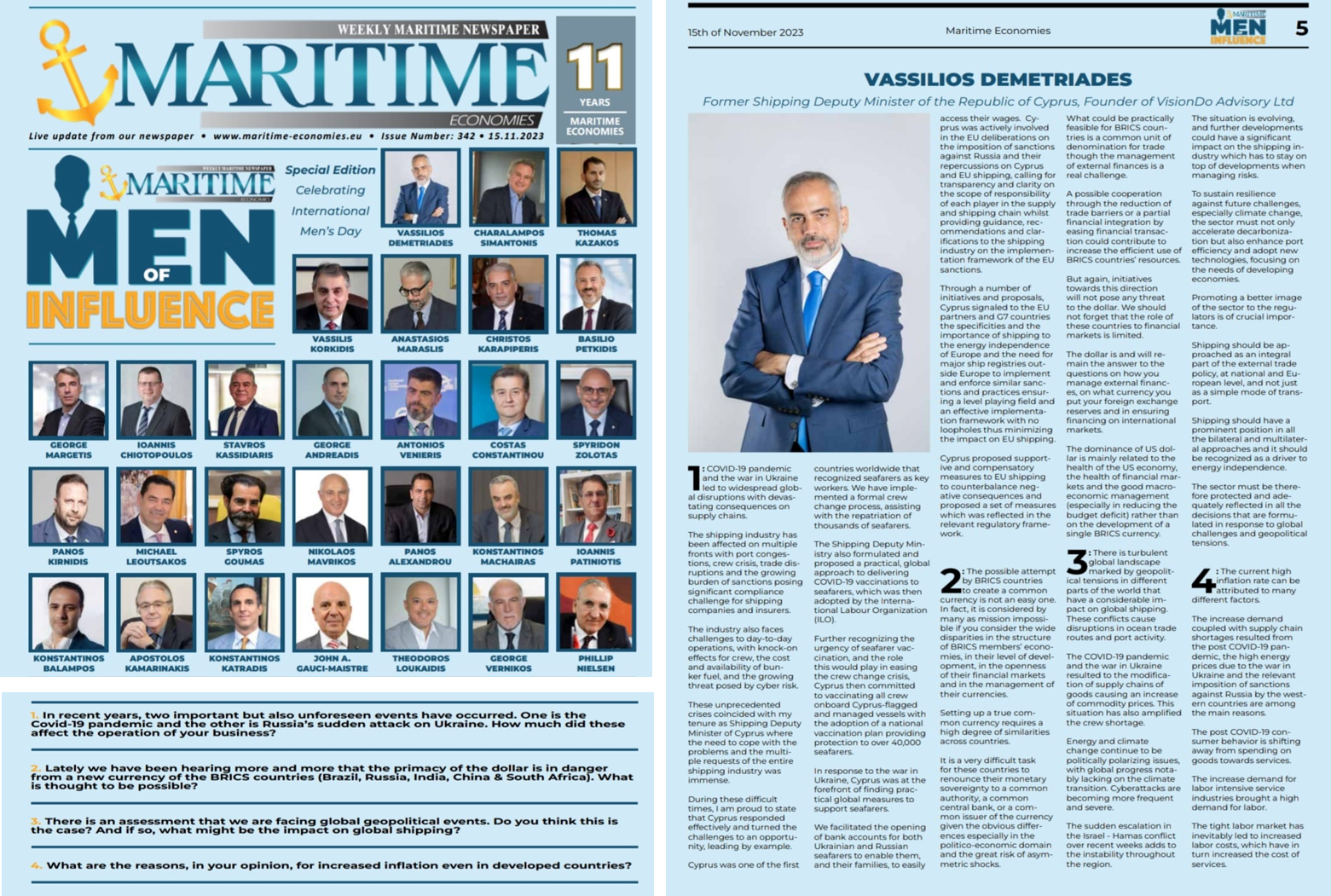
Interview on Shipping, Economics and Geopolitics
1. In recent years, two important but also unforeseen events have occurred. One is the Covid-19 pandemic and the other is Russia's sudden attack on Ukraine. How much did these affect the operation of your business?
COVID-19 pandemic and the war in Ukraine led to widespread global disruptions with devastating consequences on supply chains. The shipping industry has been affected on multiple fronts with port congestions, crew crisis, trade disruptions and the growing burden of sanctions posing significant compliance challenge for shipping companies and insurers. The industry also faces challenges to day-to-day operations, with knock-on effects for crew, the cost and availability of bunker fuel, and the growing threat posed by cyber risk.
These unprecedented crises coincided with my tenure as Shipping Deputy Minister of Cyprus where the need to cope with the problems and the multiple requests of the entire shipping industry was immense. During these difficult times, I am proud to state that Cyprus responded effectively and turned the challenges to an opportunity, leading by example.
Cyprus was one of the first countries worldwide that recognized seafarers as key workers. We have implemented a formal crew change process, assisting with the repatriation of thousands of seafarers. The Shipping Deputy Ministry also formulated and proposed a practical, global approach to delivering COVID-19 vaccinations to seafarers, which was then adopted by the International Labour Organization (ILO). Further recognizing the urgency of seafarer vaccination, and the role this would play in easing the crew change crisis, Cyprus then committed to vaccinating all crew onboard Cyprus-flagged and managed vessels with the adoption of a national vaccination plan providing protection to over 40,000 seafarers.
In response to the war in Ukraine, Cyprus was at the forefront of finding practical global measures to support seafarers. We facilitated the opening of bank accounts for both Ukrainian and Russian seafarers to enable them, and their families, to easily access their wages. Cyprus was actively involved in the EU deliberations on the imposition of sanctions against Russia and their repercussions on Cyprus and EU shipping, calling for transparency and clarity on the scope of responsibility of each player in the supply and shipping chain whilst providing guidance, recommendations and clarifications to the shipping industry on the implementation framework of the EU sanctions.
Through a number of initiatives and proposals, Cyprus signaled to the EU partners and G7 countries the specificities and the importance of shipping to the energy independence of Europe and the need for major ship registries outside Europe to implement and enforce similar sanctions and practices ensuring a level playing field and an effective implementation framework with no loopholes thus minimizing the impact on EU shipping. Cyprus proposed supportive and compensatory measures to EU shipping to counterbalance negative consequences and proposed a set of measures which was reflected in the relevant regulatory framework.
- Lately we have been hearing more and more that the primacy of the dollar is in danger from a new currency of the BRICS countries (Brazil, Russia, India, China & South Africa). What is thought to be possible?
- There is an assessment that we are facing global geopolitical events. Do you think this is the case? And if so, what might be the impact on global shipping?
- What are the reasons, in your opinion, for increased inflation even in developed countries?