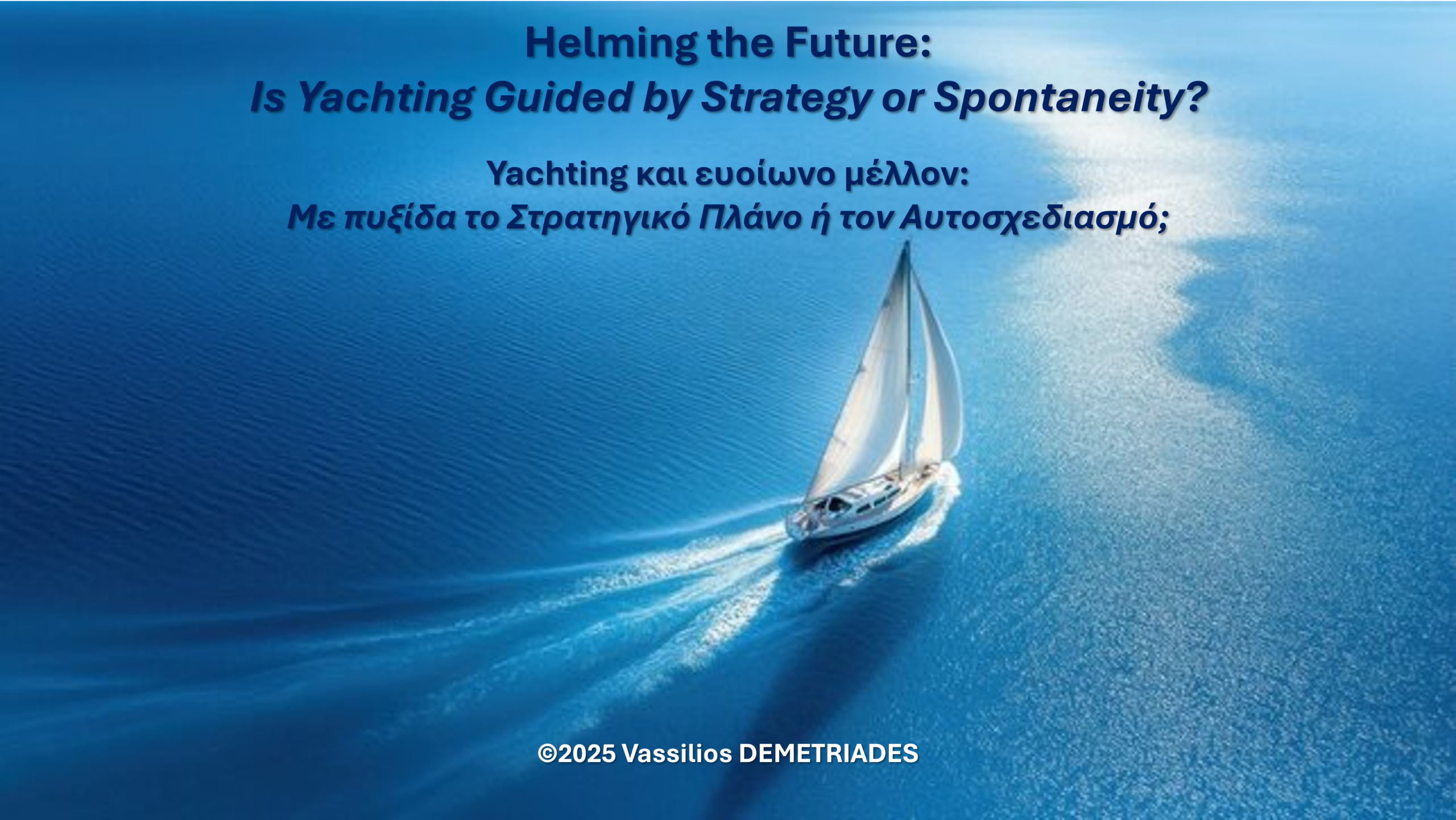
Keynote Address at the 3rd International Conference on Luxury Tourism in Greece
Santorini, 18–19 October 2025
Introduction: A Sector at a Crossroads
Yachting stands at a defining crossroads for Europe. It can either continue along a path shaped by fragmented regulations, ad hoc decisions, and environmental strain, or it can evolve through a cohesive strategic framework that aligns economic growth with sustainability, innovation, and safety. The question is no longer whether yachting matters, but whether it will be guided by strategy or left to spontaneity.
Within the broader context of the Blue Economy, yachting is far more than a luxury activity. It is an economic engine, an innovation platform, and a powerful lever for regional development. How Europe chooses to govern and integrate this sector will influence its competitiveness for decades to come.
Economic Opportunity: A Powerful Multiplier
Yachting is already a strong contributor to the European economy. It supports more than
280,000 jobs across Europe, generates
billions of euros in GDP, and sustains thousands of small and medium-sized enterprises throughout coastal regions.
Beyond headline figures, the economic profile of the yachting visitor is particularly significant. Yacht tourists typically spend multiple times more than the average traveler, creating a strong and immediate impact on local economies—from ports and shipyards to hospitality, gastronomy, and specialized services.
With a strategic approach, yachting can act as an investment multiplier. By strengthening regional economies, creating skilled and high-quality employment, and supporting SMEs, Europe—and Greece in particular—can secure a leading global position in maritime tourism.
Environmental Pressure: From Risk to Opportunity
Despite its economic promise, yachting also exerts pressure on marine ecosystems. Fuel emissions, wastewater discharge, single-use plastics, non-recyclable materials, and uncontrolled anchoring increasingly threaten fragile coastal and marine environments.
The critical question is clear:
Do we want yachting to be associated with pollution, or with sustainability?
The answer must be European and collective. Key measures include:
- The development of sustainable anchorage systems
- Zero-emission infrastructure in marinas, including shore power, charging stations, and waste collection points
- Common standards for waste management across marinas and vessels
- Incentives for green propulsion technologies
Aligned with the
European Green Deal and the
Ocean Pact, yachting can move from being perceived as a potential polluter to becoming a pioneer of the green transition within the Blue Economy.
Regulatory Fragmentation: The Cost of Disunity
One of the greatest obstacles to sustainable yachting development in Europe is regulatory fragmentation. Each member state applies different rules for vessel registration, charter licensing, taxation, and crew certification. The result is a regulatory mosaic that creates
cost, uncertainty, and unfair competition.
The solution lies in the creation of a
Single European Yachting Market, supported by:
- Minimum common standards for ship registries, safety, and training
- A unified charter licensing framework
- Mutual recognition of crew certificates
- A digital single portal for customs and port procedures
Such harmonization would reduce administrative burdens, promote transparency, and allow the sector to grow on a level playing field.
Integration into Tourism: A Holistic Approach
Yachting should not exist in isolation from broader tourism strategies. On the contrary, it should be integrated into national and European tourism plans as a pillar of sustainable development.
Strategic integration allows for:
- The creation of themed yachting routes linked to cultural heritage, natural parks, and gastronomy
- Training programs for local communities to participate in and benefit from maritime tourism
- The extension of the tourist season
- The redistribution of tourism pressure from overcrowded destinations to smaller or emerging regions
When aligned with sustainable tourism policies, yachting becomes a powerful tool for balanced and resilient coastal development.
Innovation and Industry: A Strategic Advantage for Europe
Yachting is not only a tourism activity; it is a high-value industrial ecosystem. Europe has the potential to lead globally in
green yachting innovation, including:
- Electric and hybrid vessels
- Artificial intelligence for navigation
- Recyclable and sustainable materials in shipbuilding and decommissioning
- Smart marinas equipped with digital booking, energy management systems, and water quality sensors
To unlock this potential, Europe needs coordinated action and targeted funding. Dedicated resources from
Horizon Europe, the
European Maritime, Fisheries and Aquaculture Fund (EMFAF), and fiscal incentives can support research, innovation, and collaboration among shipyards, startups, universities, and research centers.
Safety, Protection, and Data: A New Operational Standard
As the sector evolves, so too must its safety and governance tools. A modern yachting ecosystem requires:
- An expanded role for the European Maritime Safety Agency (EMSA), including recreational vessels
- Specialized weather forecasting systems for yacht traffic
- Stronger cross-border cooperation in inspections and enforcement
- A European data hub collecting information on vessel movements, environmental conditions, and tourism flows
Through intelligent use of data, Europe can enhance transparency, support better decision-making, and position yachting as a model of safety and responsibility.
The Case for a European Yachting Strategy
Other global regions are moving decisively with long-term planning and coordination. Europe cannot afford to remain fragmented. Yachting intersects with tourism, energy, shipbuilding, employment, and environmental policy—making it a core element of the Blue Economy that demands a holistic approach.
A
European Yachting Strategy should encompass:
- Regulatory harmonization across member states
- Investment frameworks for green innovation and smart infrastructure
- Integration into sustainable tourism strategies
- Enhanced safety, transparency, and data-sharing mechanisms
- Effective use of EU funding instruments
Such a strategy would guide national policies, set clear priorities, and ensure that yachting is recognized not as a privilege for the few, but as a strategic opportunity for all Europeans.
Conclusions and Recommendations: Strategy Over Spontaneity
If yachting continues without coordination, Europe risks losing economic opportunities, failing to protect marine ecosystems, and falling behind more strategic regions.
With a strategic plan, however, yachting can:
- Strengthen economies and create quality jobs
- Become a global model of sustainability
- Provide regulatory certainty and stability
- Support Europe’s innovation and industrial leadership
- Integrate seamlessly into a holistic Blue Economy vision
Greece, with its maritime heritage and expertise, must play an active role in shaping a
European White Paper on Yachting, which can serve as the foundation for national strategies and action plans.
The forthcoming
European Tourism Strategy should explicitly recognize the need for a European yachting framework, while the European Commission should initiate the development of the White Paper to define objectives, measures, and implementation pathways.
The best time to act was years ago! The second-best time is now!