
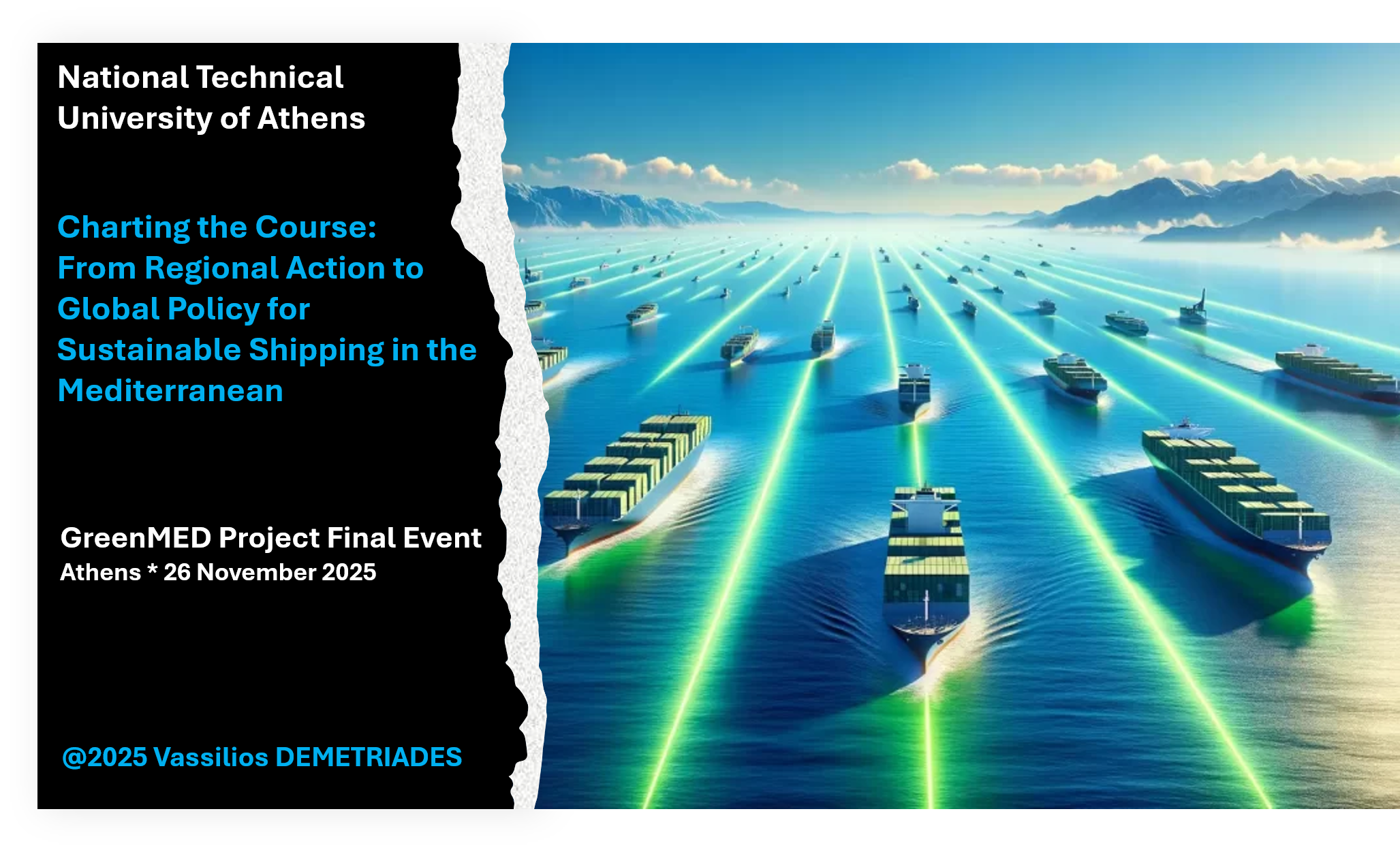
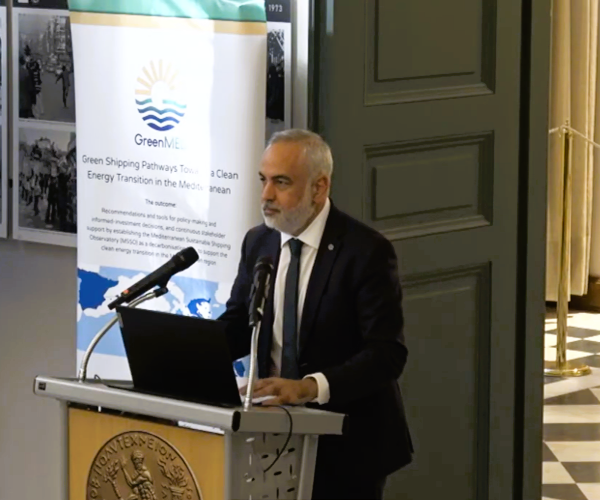
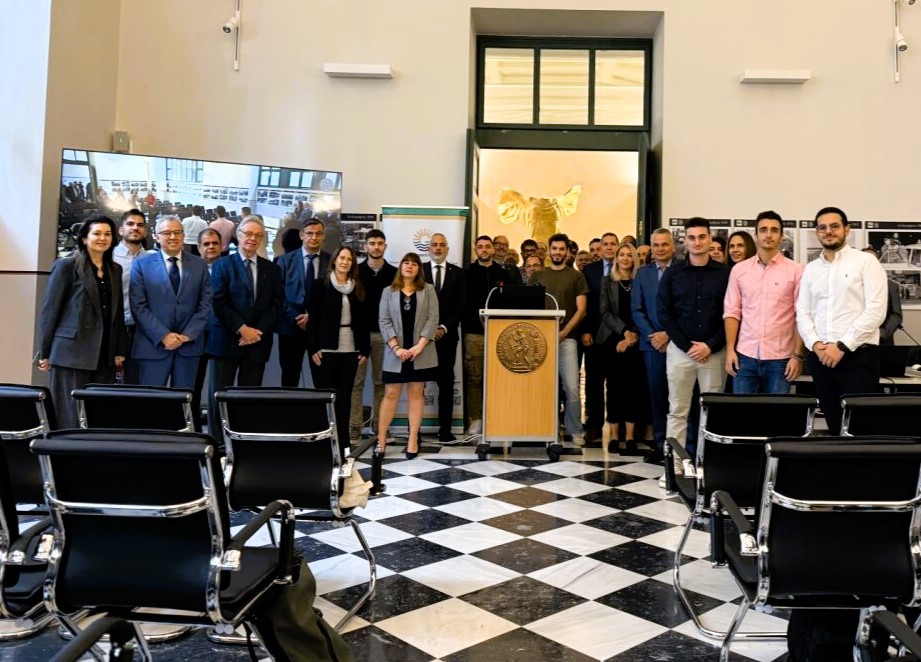
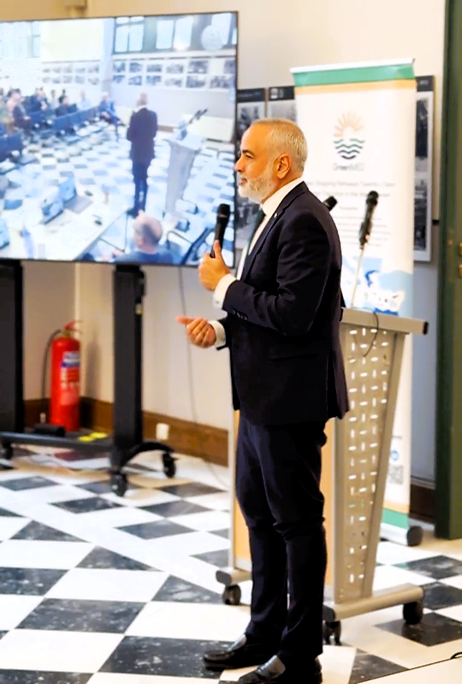
Keynote Address – GreenMED Project (co-funded by the EU) final event at the National Technical University of Athens
Ladies and gentlemen, colleagues and friends,
It is a privilege to join you today at the Final Event of GreenMED — “From Insights to Impacts – Designing the Future of Sustainable Shipping in the Mediterranean.” I am really grateful to the Organizers for the invitation.
We gather at a decisive moment where regional projects, national policies and international negotiations are converging to formulate the future of maritime activity across the Mediterranean.
The decisions we make now — as policymakers, industry, and researchers — will determine whether our region becomes a frontrunner in maritime decarbonization or a laggard struggling to catch up.
My remarks today will cover three parts:
- First, the current state of global and regional policy formulation for maritime decarbonisation and the brief but important pause we have just seen at the IMO.
- Second, the present and near-term impacts these policy choices are having — and will have — on the Mediterranean shipping ecosystem.
- And third, how the GreenMED project can and should support the green transition effectively: practically in the ports and supply chains, and strategically in designing a policy framework that is fit for purpose, durable and equitable.
Global and regional policy developments — where we stand
Let us begin with the policy landscape. Over the last few years we have seen two complementary but differently paced processes.
At the global level, the International Maritime Organization has raised its ambition. The revised IMO GHG Strategy commits the shipping sector to a pathway that aims for net-zero emissions by mid-century and sets more stringent interim targets for 2030 and 2040. The IMO’s approach is to deliver a package — a “basket of measures” — combining technical and operational standards with an economic instrument that can be applied internationally.
However, the IMO process is consensual, and consensus is hard. As you know, negotiators recently postponed adoption of a global market-based measure for one year. That postponement is disappointing to many, but it is also instructive: it highlights the political and technical complexities of designing a measure that is globally acceptable, technically feasible, and fair across developed and developing countries. It also produces a pragmatic window — a single, valuable year — in which the international community can improve the technical basis for agreement and build political confidence.
At the regional level, the European Union has moved decisively, translating ambition into instruments. The EU has brought maritime emissions into its ETS, introduced FuelEU Maritime to require progressively lower greenhouse-gas intensity of shipping energy, and tightened MRV rules. These measures are not theoretical: they impose real obligations and costs, and they change investment signals across the sector overnight.
The Mediterranean also has important regional governance. The basin has embraced air-quality measures such as the Med SOx ECA and benefits from targeted regional cooperation through conventions and centres of expertise. But the Mediterranean is also a patchwork: EU and non-EU states, developed and developing ports, different fleets and trading patterns. That heterogeneity matters greatly for how policy plays out on the water.
So, the picture is clear: Europe is leading with concrete regulation, the IMO aims for a global framework but moves more slowly, and regional instruments and institutions can bridge the gap — if they are fed with the right evidence and designed with equity in mind.
Current and future impacts on the Mediterranean shipping ecosystem
These policy developments are not abstract. They are already reshaping incentives, costs and the operational habits of shipowners, ports and logistics providers — and they will continue to do so.
First, cost and competitiveness. Carbon pricing and fuel standards raise operating costs for vessels that rely on fossil fuels. Ships with modern engines, alternative-fuel capability, or access to green fuels will be advantaged. Conversely, older tonnage or ships that operate primarily in ports without green bunkering risk becoming uncompetitive. This dynamic will reconfigure trading patterns, charter markets and investment flows.
Second, infrastructure and supply chains. Demand for alternative fuels — methanol, ammonia, hydrogen, biofuels, and electricity for short-sea and passenger vessels — will spike. Ports that have bunkering, storage and safety systems for these fuels will attract traffic; those that do not will be bypassed or will have to bear higher retrofit costs later. The risk of stranded assets is real if investments are uncoordinated.
Third, operational behavior and local impacts. Measures such as shore power, slow steaming, or NOₓ controls produce immediate air-quality and public-health benefits in the Mediterranean’s densely populated coastal zones. These co-benefits generate local political support for measures that might otherwise be contested purely on economic grounds.
Fourth, governance and fragmentation. A two-speed system — strong regional rules in the EU and a delayed global instrument — may generate regulatory fragmentation. Different compliance regimes across the basin will increase administrative burdens on ship operators and could incentivise routing decisions designed to minimize compliance obligations rather than emissions.
Finally, equity and capacity. Non-EU Mediterranean states, smaller ports and local maritime workforces may lack the capital and technical capacity to respond quickly. Without coordination, the transition risks exacerbating regional inequalities.
In short: policy is already altering the ecosystem. The challenge now is to steer these impacts so they accelerate decarbonisation while preserving connectivity, economic opportunity and fairness.
How GreenMED can support and accelerate a just, effective transition
This is where GreenMED’s contributions are essential. Your project sits in the middle of the very gap I have described: between regulatory ambition and practical feasibility. I will describe three interdependent roles GreenMED can play — as an evidence hub, as a practical enabler, and as a policy partner — and give concrete recommendations for each.
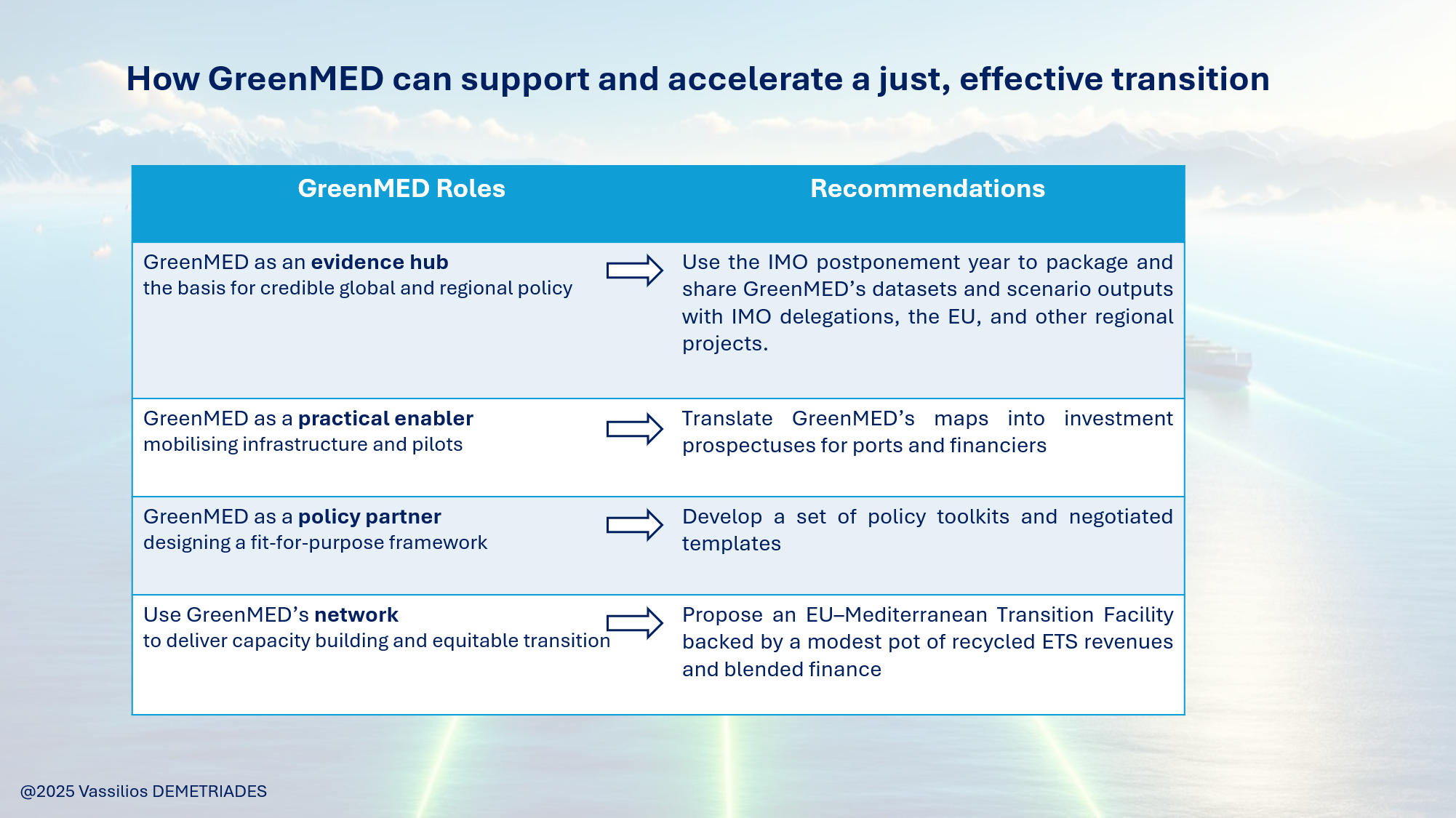
a) GreenMED as an evidence hub — the basis for credible global and regional policy
One of the reasons the IMO paused is that negotiators rightly want better, regionally relevant evidence: on fuel lifecycle emissions, on costs and availability of alternative fuels, on infrastructure readiness, and on distributional impacts. GreenMED’s mapping of alternative fuel supply chains, technology readiness assessments, and scenario modelling is precisely the evidence that a stalled global process needs.
Recommendation:
Use the IMO postponement year to package and share GreenMED’s datasets and scenario outputs with IMO delegations, the EU, and other regional projects. Transparent, peer-reviewed analyses showing the Mediterranean’s cost curves, fuel-availability timelines and infrastructure priorities will reduce uncertainty and rebut arguments that a global measure is impractical. In short: evidence lowers political risk.
b) GreenMED as a practical enabler — mobilizing infrastructure and pilots
Regulation creates demand; supply must follow. GreenMED’s supply-chain maps identify which ports are logical early adopters for specific fuels. Your work on pilot projects and technology assessments can be converted into bankable project pipelines.
Recommendation:
Translate GreenMED’s maps into investment prospectuses for ports and financiers — short, actionable packages showing required capex, expected fuel uptake under EU and potential IMO scenarios, and revenue models (including ETS revenue recycling). Encourage pilots (e.g., green methanol bunkering at a hub port, shore power for a high-traffic ferry route, or ammonia trials for short-sea shipping) that demonstrate technical feasibility and reduce perceived risk for investors.
c) GreenMED as a policy partner — designing a fit-for-purpose framework
Policy works best when it is iterative and grounded in reality. GreenMED can help governments design or revise regulatory instruments that are both ambitious and implementable: targeted transitional reliefs, standardized MRV templates, interoperable fuel sustainability criteria, and revenue recycling mechanisms to support infrastructure in less wealthy ports.
Recommendation:
Develop a set of policy toolkits and negotiated templates. For example: model language for MRV interoperability; a template for fuel sustainability certification and methane-slip accounting; and options for ETS revenue recycling earmarked for Mediterranean port upgrades. These are precisely the types of products the IMO and the EU need to avoid fragmentation.
d) Use GreenMED’s network to deliver capacity building and equitable transition
Transition is not only about technologies — it is about people and institutions. GreenMED’s Mediterranean Sustainable Shipping Observatory (MSSO) and stakeholder network position it to coordinate capacity building: training for port staff, safety workshops for new fuel handling, and regulatory support for non-EU partners.
Recommendation:
Propose an EU–Mediterranean Transition Facility backed by a modest pot of recycled ETS revenues and blended finance, targeted at North African and Eastern Mediterranean ports. GreenMED can design the eligibility criteria, project pipeline and monitoring framework for that facility, ensuring funds deliver both decarbonization and social co-benefits.
Using the one-year IMO postponement constructively
Let me return to that crucial one-year delay at the IMO. A postponement can be political theatre, or it can be a strategic pause. I urge us to treat it as the latter.
Action steps for this year:
- Rapidly disseminate GreenMED’s key findings to IMO delegations and regional coalitions. Make the case: here is what the Mediterranean’s fuel costs look like under different uptake scenarios; here is what infrastructure is needed and when.
- Run targeted pilots that reduce uncertainty. A couple of well-chosen demonstrations — a green fuel corridor between two ports, or a shore-power rollout for major ferry routes — provide tangible proof that policy is workable.
- Convene cross-border stakeholder dialogues linking EU, non-EU states and industry to build political trust and flesh out equitable revenue/reinvestment models.
- Agree technical harmonisation: MRV interoperability, sustainability criteria and methane accounting methodologies should be standardised at the regional level now so they can be proposed at IMO with credibility.
If we use this year to produce evidence, run pilots and build trust, the probability of a globally agreed, durable measure rises substantially.
Final reflections — governance, legitimacy, and momentum
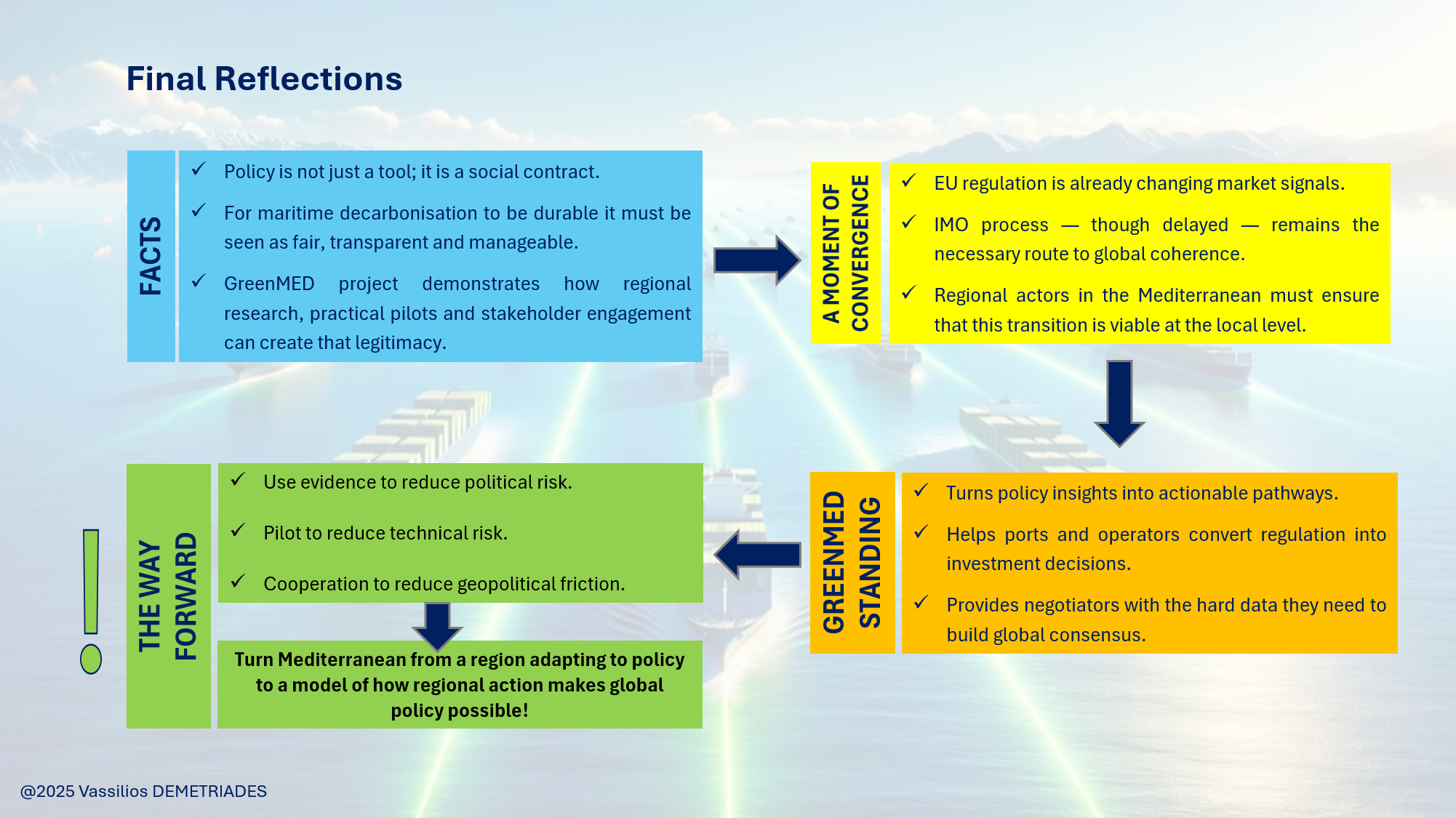
Policy is not just a tool; it is a social contract. For maritime decarbonisation to be durable it must be seen as fair, transparent and manageable. The GreenMED project demonstrates how regional research, practical pilots and stakeholder engagement can create that legitimacy.
We are in a moment of convergence: EU regulation is already changing market signals; the IMO process — though delayed — remains the necessary route to global coherence; and regional actors in the Mediterranean must ensure that this transition is viable at the local level.
GreenMED stands between these levels. Your work turns policy insights into actionable pathways, helps ports and operators convert regulation into investment decisions, and provides negotiators with the hard data they need to build global consensus.
So let us be purposeful. Let us use evidence to reduce political risk, pilots to reduce technical risk, and cooperation to reduce geopolitical friction. If we do this, the Mediterranean can become more than a region adapting to policy — it can become a model of how regional action makes global policy possible.
I look forward to our discussion and to learning how we can move from insight to real, equitable impact — together.
Thank you.