Addressing BusinessEurope Council of Presidents
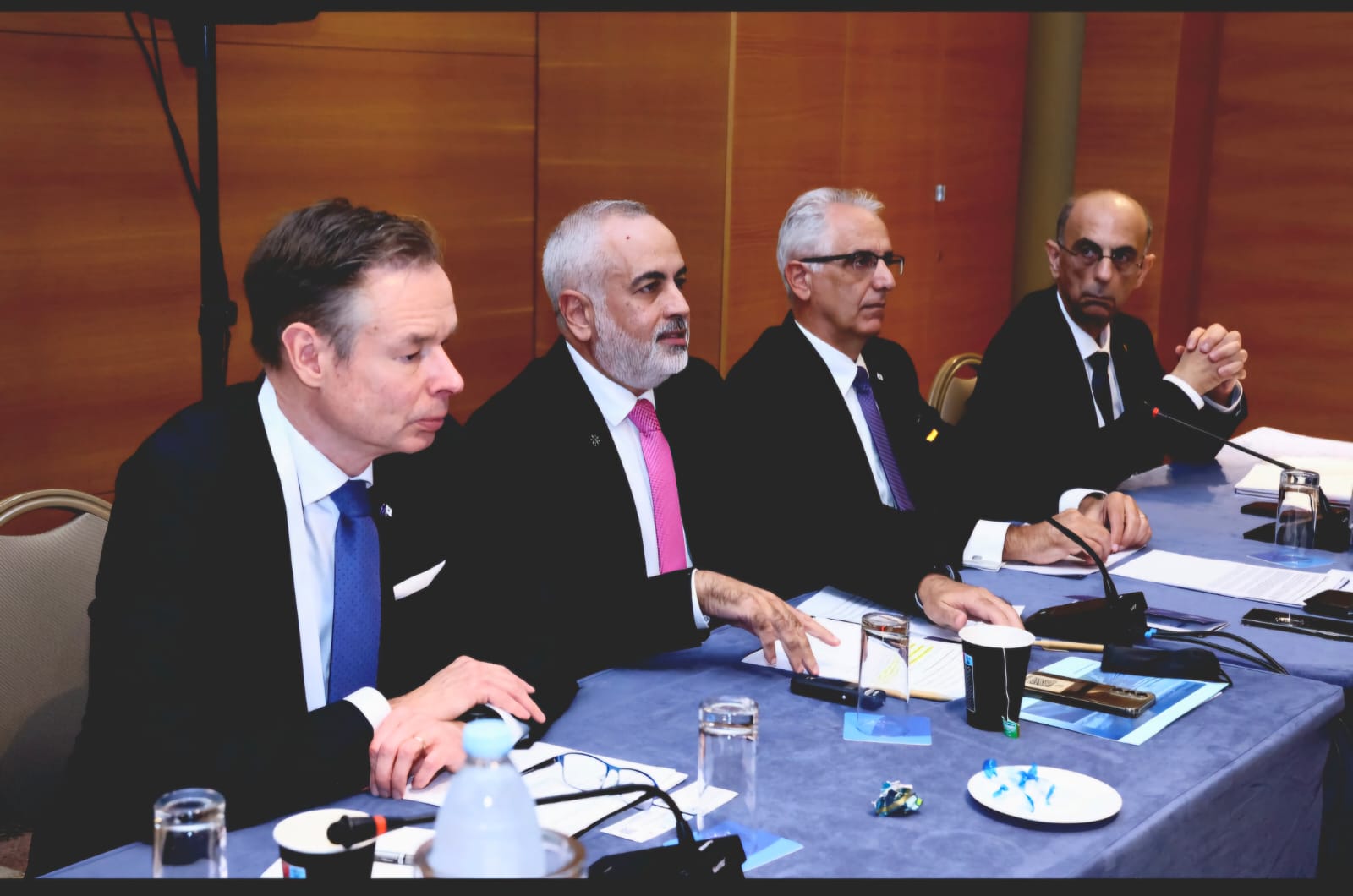
Ladies and Gentlemen,
It is a privilege to address you today at a moment when Europe’s maritime sector stands at a
historic crossroads. We meet at a time when the very foundations of global trade, the stability of supply chains, and the resilience of economic systems are being tested more intensely than at any other point since the end of the Cold War.
For decades, shipping has been treated mainly as a mode of transport — an efficient service whose core responsibility was to move goods across oceans as reliably and cost-effectively as possible. But the crises we have faced over the past years — from Russia’s war in Ukraine and its impact on Black Sea routes, to the Israel–Hamas conflict destabilizing the Eastern Mediterranean, and the persistent Houthi attacks in the Red Sea forcing large-scale rerouting — have revealed a deeper truth:
shipping is not merely transport. It is a strategic enabler of Europe’s security, competitiveness, and geopolitical influence.
And that is why today I want to deliver one central message:
EU shipping must no longer be seen only within the boundaries of transport policy — it must be positioned at the core of the European Union’s external, trade, and industrial policies.
Only then will Europe be capable of protecting its interests, preserving its competitiveness, and shaping global developments rather than simply reacting to them.
1. Shipping as the Backbone of Europe’s Economy
Let us begin with the fundamentals.
More than three-quarters of the EU’s external trade travels by sea. This is not simply a statistic — it is a reality that underpins every part of Europe’s economy.
Shipping brings Europe its energy — LNG shipments, crude oil, refined products, and increasingly, green fuels for the transition. It brings our raw materials — metals, chemicals, rare earths, and agricultural products necessary for industry and food security. It brings our manufactured goods — everything from automobiles to electronics, pharmaceuticals, textiles, and machinery.
This means that shipping sustains
millions of jobs, not only at sea or in ports but across supply chains, logistics hubs, export industries, and even retail. And when trade routes are disrupted, the consequences are not abstract or distant. They show up immediately in the lives of European citizens:
- in higher electricity bills when energy shipments are delayed,
- in higher prices for everyday goods when logistical costs surge,
- in shortages and supply tensions when factories lack essential components,
- and in inflationary pressure that affects households across all income levels.
Shipping, in other words, is Europe’s
economic bloodstream.
And if that bloodstream clogs — whether due to conflict, protectionism, or regulatory imbalance — the entire economy suffers systemic consequences. No other sector is as central to ensuring continuous flow and economic resilience.
2. Competitiveness Under Pressure
But that economic bloodstream is now under unprecedented strain.
Geopolitical instability has forced vessels to reroute thousands of miles, leading to higher emissions, longer transit times, and dramatically increased costs. The disruptions caused by attacks in the Red Sea alone have contributed to a doubling of freight rates on some routes — with immediate downstream effects.
Global trade fragmentation is accelerating. We see a rise in protectionism, preferential national fleets, and competition from state-backed non-EU actors whose cost structures and regulatory environments differ dramatically from those in Europe.
Regulatory asymmetries place European fleets at a competitive disadvantage. The EU leads in sustainability and safety — and rightly so — but global competitors often operate under less stringent regimes, benefiting from reduced compliance costs while accessing the same global markets.
Inflationary pressures amplify all of this. Every euro added to transport and logistics feeds directly into the cost of goods on supermarket shelves and industrial inputs, exacerbating inflation. And because shipping is the most cost-sensitive link in the supply chain, even small cost increases ripple globally.
If shipping costs spiral, European industry loses international competitiveness, and households face higher consumer prices.
Protecting shipping competitiveness, therefore, is not an interest of the maritime community alone —
it is a strategic economic necessity for the entire Union.
3. From Transport to Strategy
It is clear that the traditional vision of shipping as a neutral, technical transport function no longer serves Europe’s needs. That perspective belongs to a bygone era.
Shipping has become a
strategic asset — the platform on which Europe’s trade, security, foreign policy, and industrial capacity depend. It is as essential today as energy supply, digital infrastructure, or defence capability.
To remain competitive in an increasingly turbulent world, the EU must develop a
strategic maritime vision that brings together all relevant policy areas — transport, trade, industrial policy, security, and diplomacy — under one coordinated framework.
Such a shift is not merely administrative. It is conceptual.
It means recognising that a resilient Europe requires resilient shipping.
That the EU’s global influence depends on the safety and autonomy of its maritime routes.
And that shipping is a geopolitical capability — not only an economic one.
4. The Role of the Upcoming EU Maritime Industrial Policy
The forthcoming
EU Maritime Industrial Policy, currently under development by the European Commission, has the potential to reshape Europe’s maritime landscape for decades to come.
This policy will bring together the entire maritime ecosystem: shipping, shipbuilding, equipment manufacturing, ports, nautical services, and digital infrastructure. It recognises that maritime competitiveness depends on the strength of the entire value chain.
Key elements expected to form the backbone of this policy include:
Green innovation and decarbonisation
Alternative fuels, port electrification, green corridors, and retrofitting technologies will define competitiveness in the coming decade.
Strategic autonomy in shipbuilding and equipment
Europe cannot afford to rely excessively on third-country suppliers for vessels, critical components, and maritime technologies essential for defence and economic security.
Digitalisation and data infrastructure
Maritime cybersecurity, digital twins for ports, and smart navigation systems will improve efficiency, reduce emissions, and enhance safety.
Financing instruments
European operators and ports need access to competitive financing to maintain a level playing field against state-backed competitors.
Integrating shipping deeply into this industrial framework will:
- reinforce Europe’s leadership in green and smart maritime technologies,
- secure critical capabilities across the value chain,
- and align shipping competitiveness with Europe’s broader industrial and geopolitical objectives.
In essence, the Maritime Industrial Policy can become the economic engine of a
strategic, resilient, and sovereign maritime Europe.
5. Shipping in EU Trade Policy
Turning now to trade policy.
Shipping is the essential enabler of Europe’s external commerce — but it remains insufficiently recognised in the structure of EU Free Trade Agreements.
This must change.
Every new FTA should include a
dedicated maritime chapter, ensuring:
- Freedom of navigation and secure maritime routes, rooted in international law and mutually supported commitments.
- A level playing field for European shipping companies, avoiding distorting practices, cargo reservation policies, or unfair subsidies.
- Investment and cooperation frameworks for port infrastructure, logistics connectivity, and maritime services.
When shipping is properly embedded into EU trade policy, supply chains become more resilient, European operators gain stronger market access, and more value — economic and strategic — is retained within Europe.
6. Shipping in the EU’s External Policy
But even trade policy is only one dimension of Europe’s maritime role. Shipping is increasingly a central tool of EU
external policy.
This requires a new set of concrete actions:
Maritime diplomacy
Deepening engagement with strategic partners to secure sustainability and predictability in global maritime corridors.
Maritime security missions
Strengthening EU naval operations to protect chokepoints such as the Red Sea, the Black Sea, and the Strait of Hormuz — essential arteries of European commerce.
Global Gateway investments
Enhancing port capabilities, logistics corridors, and maritime connectivity across Africa, Asia, and Latin America.
International partnerships for maritime resilience
Supporting developing countries in building maritime capacity helps stabilise global trade and enhances Europe’s influence.
This integrated approach transforms shipping policy into a tool for foreign policy, economic security, and industrial strength — a triple advantage Europe cannot afford to ignore
7. Three Strategic Priorities
To deliver this vision, Europe must embrace three overarching strategic priorities:
- Security for competitiveness
Freedom of navigation is essential.
Without secure sea lanes, there can be no competitive European industry and no stable prices for citizens.
- Fair and balanced regulation
Europe must lead the global sustainability transition — but without undermining the competitiveness of its own fleets. Regulation must be ambitious, but also realistic, coordinated, and globally coherent.
- Policy coherence
Transport, trade, industry, and foreign policy must align around a single strategic maritime logic. Fragmentation weakens Europe; coherence strengthens it.
8. The Cost of Inaction
If Europe does not act now, the consequences will be profound:
- higher logistics costs that feed inflation,
- erosion of market share for EU shipping companies,
- increased dependency on non-EU shipping powers,
- and a diminished global geopolitical position.
Inaction is not neutral — it carries a heavy cost for Europe’s citizens and its long-term sovereignty.
9. A Call for a New Vision
Ladies and gentlemen,
Europe’s future will be written on the sea.
Across the Mediterranean, the Baltic, the Atlantic, and all the way to the Indo-Pacific, shipping carries not just goods — but the prosperity, security, and geopolitical footprint of our Union.
The upcoming Maritime Industrial Policy, combined with stronger integration of shipping into EU trade and external policy, offers a historic opportunity to build a more resilient, competitive, and strategically autonomous Europe.
To seize this opportunity, we must change our mindset:
Shipping is not a passive service. It is a strategic capability.
Competitive shipping means a resilient Europe.
Resilient shipping means a prosperous Europe.
And strategic shipping means a sovereign Europe.
Let us therefore place shipping at the heart of Europe’s external, trade, and industrial policies — and ensure that Europe sails with confidence in the turbulent waters of the 21st century.
Thank you.